Category Archives: News / Announcements

Posts

NSS Space Elevator Competition Team – Help Wanted

A few days ago, I wrote that the National Space Society (NSS) had decided to compete in the 2008 (and 2009) Space Elevator Games with an entry in the Climber-Power/Beaming competition.

At the NSS website, Bert Murray, fearless leader of the nascent NSS team, has put out a call for volunteers:

All,

I am leading a team to compete in this year’s Elevator2010 contest. Right now the team consists of seven people. I would like to grow the team to 10 to 20 team members. In particular we need help in laser optics, and embedded controls

If you are interested please shoot me an email.

Cheers,
Bert Murray
Ellicott City, MD

hcm1955 [AT] gmail.com

D 301 698 3382
E 410 750 7497

NSS Space Elevator Chapter
NSS Space Elevator Team

As a member of NSS, it’s tempting for me to sign up.  However, I think the independence and objectivity of the Space Elevator Blog requires that I keep this at arms length.  If you’re a member of NSS though (or even if you’re not) and you’re looking for a fun project and/or a concrete way to help further the development of a Space Elevator, here’s a great opportunity for you to do so.

More updates from LaserMotive

LaserMotive has just announced an Open House on February 23rd for their new shop (mentioned earlier here).  If you are in the Seattle area and have any interest at all in Space Elevators or the technology used in the Space Elevator Games or just want to talk to anyone from the LaserMotive team, here’s your chance to take a close-up tour.

Also, I did hear from LaserMotive’s Jordin Kare about what they were up to, especially at the recently concluded Photonics West Show:

[Space Elevator Blog – SEB] – Why did Lasermotive decide to use DILAS equipment in the 2007 Space Elevator Games?
[Jordin Kare – JK] – We had been talking to a couple of other companies, and had found at least one workable option, but we held off placing an order until after Photonics West.  I talked to several manufacturers at last year’s Photonics West.  I also talked to people I knew  from a company I used to consult for, who are heavy users of laser diodes, and they strongly recommended I talk to DILAS.  I spoke to Georg Treusch at PW, and we made a deal on the spot.

[SEB] – What factors will be most important to you and Lasermotive in deciding what power source you’ll be using in this year’s Games?
[JK] – Ease of development and overall project cost.

[SEB] – Will Lasermotive be attending the Photonics West show and will Lasermotive be “interviewing” with TRUMPF for possible use of their equipment?
[JK] – I’ll be at PW, but on behalf of my employer, not (primarily) LaserMotive.  However, I’m sure I’ll talk to some of the laser companies while there.  I won’t discuss (at least for publication) any particular plans.

[SEB] – What are Lasermotive’s goals for this year’s competition?
[JK] – Compete and win!   Seriously, we have decided we’ll try to compete this year, despite the short schedule, but we are still deciding exactly what we’ll build — and we’re still very concerned about the feasibility of Spaceward’s proposed contest setup.

Thank you Jordin!

National Space Society to compete in the 2008 Space Elevator Games

While perusing the current list of team’s entered into this year’s Climber/Power-Beaming competition, I noticed that the National Space Society (NSS) had recently been added to the mix.  Now I’m a member of NSS so I was quite intrigued as to what they planned to do.  I recently spoke with Bert Murray from the NSS.  Here is what I learned from the conversation.

Bert (with the enthusiastic backing of George Whitesides, the Executive Director of NSS) has recruited the beginnings of the NSS team.  In addition to Bert (who is the team lead), the team includes Matt Abrahms (Chief Engineer), Steve Laroche (command and control), Chris Barnes, Aaron Bakos (who works at Bosch Home Applications, a company that uses Trumpf lasers for fabrication) and Al Burke (Robotics).

Matt Abrahms, as you may recall, was the guy who was behind the Starclimber entrant into the 2006 Space Elevator Games.  It’s great to see him back in the picture.

Bert is looking to expand this team (to at least 10 members) with the emphasis of making it a “senior team”.  Bert, who has 30 years experience in the aerospace and transportation industries, works at Lockheed-Martin during his “day job”.  He is looking to put together a team that has an “engineering” mindset, meaning a heavy emphasis on planning, project management and testing, testing, testing (“build a little, test a little, learn a lot”).

IMHO, the only teams with a chance to win the Climber/Power-Beaming prize now, with the requirements so high, are teams that take this engineering-management approach so I certainly concur with the way they are organizing.

They have talked with Trumpf about using their equipment as a power source; talks are ongoing.

Bert tells me that they want to compete in 2008, and hopefully win, of course, but they are starting late and are focused on the competition in 2009 as well (as is the team from the University of Michigan).

Here’s wishing them luck!

Kansas City Space Pirates to use TRUMPF Lasers in 2008 Space Elevator Games

As noted in earlier postings, both here and on the Spaceward website, TRUMPF has offered to supply ‘Laser Power’ to qualifying teams for the 2008 Space Elevator Games.

The Kansas City Space Pirates have reached an agreement with TRUMPF for use of their equipment.  Brian Turner, captain of the Space Pirates, sent out this email today to his team and supporters:

Well our trip to San Jose was a success.  After meeting with two laser companies we are happy to announce that we have an agreement to use the TRUMPF Trudisk 8002 industrial laser. This laser is the pinnacle of Industrial laser power and performance. It has an output of 8 kilowatts. We are very excited to have access to this laser.

The drawback is that the color of this laser is not well matched with the best solar cells. Our research has led us to believe we have a solution to this issue. We are going on an expedition to Detroit next week to test the underlying tech.

The issue we are struggling with now is how to aim the laser. It’s awesome power level requires exotic optics and/or special tactics. It would be no problem if we had $150,000 to throw at it. But because we have chosen not to be full time fund raisers we are looking for more creative solutions. This keeps with the spirit of the competition but of course represents a possible major barrier to our success. I will have to keep you posted on our progress in this area.

Brian
Captain
KC Space Pirates

This is MOST promising.  Anyone who has seen the Space Pirates in action for the past two competitions know how seriously this team has to be taken.  And now that they’ve ‘moved up’ to using Lasers, it has to be worrying to the other teams.

Less than 7 months to go…

Upcoming appearance of Glen Phillips

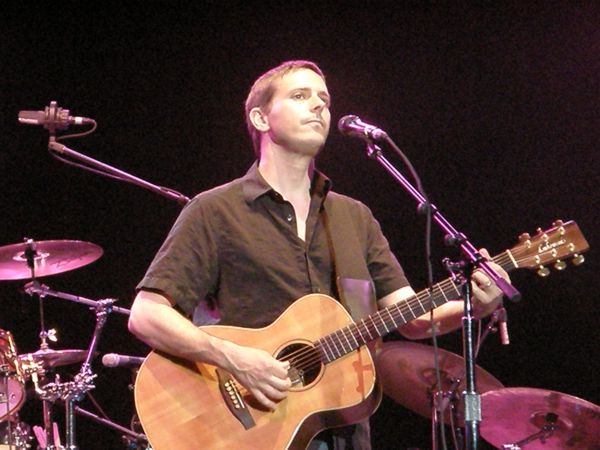
A few days ago, I wrote about a new song that Glen Phillips had written called “Space Elevator” and how much I enjoyed it.  I’d like to note that Glen will be appearing in concert at the Fox Theatre in Redwood City, CA next monday, February 18th, 2008, at 8:00pm.  You might want to check it out.  Glen is also coming to Chicago in April of this year (as part of this same US tour) and I definitely plan on attending his show then.

I’ve also been told that certain “Space Elevator luminaries” will be in attendance at this show – so here’s a chance to get an autograph (or two) 🙂

(Picture of Glen from here – click on the thumbnail for a larger version)

News from LaserMotive

Tom Nugent from LaserMotive has posted a new entry to their team blog.  Basically it states that they are “coming back to life”…

“It’s been a while since I last posted anything to this blog. The LaserMotive team has finally caught up on sleep, and worked out our plans for 2008.

The first and most important order of business we had to attend to: our own workshop. I’m glad to report that LaserMotive moved into our very own shop in January…”

I’m going to be very interested to hear what their plans are for this coming competition.  They’re “blooded” now and should be considered a serious threat to make a money-winning run in the upcoming Space Elevator Games

Click on the thumbnail for a larger version of the picture or visit their blog to read the rest of the post and to see more pictures from their new setup.

Rockin’ Space Elevator Music!

Glen Phillips is releasing a new album, available February 26th, entitled Secrets of the New Explorers.  It contains a soundtrack entitled “Space Elevator” and it ROCKS!!

I’m emailing them, asking if I can purchase the license rights to it so I can post it on this blog.  In the meantime, if you go to his homepage and give it a few seconds to load, you’ll see the song in the upper left-hand corner of the web page.  Click on the play button and ENJOY!

If you’re a Nickle Creek fan (like me), the style will sound very familiar.

Lyrics:

take me up to the top
and don’t stop
you look down
can’t comprehend such a long drop
twenty thousand miles
i’m not a liar
i tell you steven tyler’s wishing
he could have a piece of
this ascending movable feast
paydirt, payload, heave-ho
pack your halliburton and let’s go

space elevator

we’ve no need for escape velocity
we’re free
with every mile higher we lose the weight of gravity
climb the tether together
heading for the counterweight
up the carbon nanotube
spiderweb into space

you’re gonna love it here
get undressed in the mesosphere
get so hot in the thermosphere
you know what’s coming the exosphere

space elevator

don’t look down don’t look down don’t look

And he’s coming to Chicago in April – oh yeah, oh yeah, oh yeah!

Nanotubes, the environment and human health

Concerns have been raised by many about how safe it would be to release carbon nanotubes into the environment.  Some of this is overblown I think as nanotubes occur in small quantities naturally (as a byproduct of a wood fire, for example).  Nevertheless, I think the concerns are real and I’m glad that research is ongoing on this subject, especially as one sees stories now (like here) about lung problems being perhaps associated with very small particles jettisoned into the air by combustion engines.

One recent studyfrom Stanford shows that nanotubes in the bloodstream can exist safely within the body and are excreted in the “normal way”.  Not only that, but nanotube based delivery systems for medicines hold much promise to treat human health problems.

But I’d still like to see some studies about what happens when nanotubes are inhaled.  I’m sure there are nanotube development researchers who are now unwittingly being guinea pigs in this area as they work to create nanotube-based materials (like tethers).  At some point if/when nanotube strength gets to the point where a Space Elevator is really possible, this is going to be one of the concerns raised.  Of course, this theoretical release of nanotubes into the environment as a potential pollutant will have be balanced against the very real pollution which is a byproduct of today’s rocket programs.

(Hat tip to Andy Price for pointing out the Stanford Article.  Graphic from here.)

News from EuroSpaceward

The 2nd European Workshop on Space Elevator Design has been tentatively rescheduled to Oct 18-19, 2008.  EuroSpaceward’s Markus Klettner emails me that this date will depend on when this year’s Space Elevator Games (now scheduled to begin on September 8th this year) actually occur.

Our friends across the pond certainly have a busy schedule this year:

February 20-22, 2008 ISU, Strasbourg-Illkirch, France
EuroSpaceward’s poster session on Why we need an elevator to space!
International Space University’s
12th Annual International Symposium

Sep 23-24, 2008 European Lift Congress 2008, Heilbronn, Germany
EuroSpaceward’s presentation by Dr. Brad Edwards:
The Space Elevator: Design and Technical Challenges

Oct 1, 2008, Session D4, IAC Glasgow, United Kingdom
Space Elevators and Advanced Tethers – Roadmaps to the Future

Oct 18-19, 2008: 2nd European Workshop on Space Elevator Design, Luxembourg

For schedule updates, visit the EuroSpaceward website or check back here.

TRUMPF

Regular readers of this blog or those that follow the goings-on at the Spaceward site know that TRUMPF decided to help out, big-time, in the upcoming Space Elevator Games.  This is well-summarized on the Spaceward web site:

“We’re thrilled to announce that Laser tool manufacturer TRUMPF has stepped forward with a lucrative offer to support teams with its state-of-the-art laser equipment.

Being the world leader in laser technology, TRUMPF took a natural interest in the power beaming games, and is providing both hardware and expertise to enable the 1-km climb.”

I have posed several questions to TRUMPFlger Schlueter about the technology, the upcoming games and TRUMPF’s goals.  He (and Dave Marcotte, also of TRUMPF) have kindly answered.  Note that if you are unable to read all of the slides or the table, you can click on them for a larger version.

Space Elevator Blog [SEB] – I noticed that in the current issue of “Laser Community” (http://www.trumpf-laser.com/208.img-cust/Laser_Community_03-2007_en.pdf), a TRUMPF publication, the last page states the following: “100,000 Kilometers: Across this distance, laser beams may one day power the motors of the so-called Space Elevator…”  Before last year’s Space Elevator Games, were you aware of the concept of the Space Elevator?  If so, how did you learn about it?
Holger Schlueter [HS]– Hello Ted !  TRUMPF is a big, multinational company – I actually saw the laser community magazine for the first time yesterday. I was as surprised as you. TRUMPF in Germany was obviously as intrigued by the space elevator concept as we were here in the United States. Maybe they had read the same Spiegel Online article that I had read. Well, anyways, end of October I sent Ben a message with a terribly faulty calculation claiming the space elevator would never work because of the beam divergence. Ben, being the nice and courteous person he is, wrote back friendly and humbly pointed out the embarrasing mistake I had made. So I did the calculation again and realized you actually can transmit a multi-kW laser beam several hundred thousand km into space with manageable divergence. So I repented 😉 and a very good relationship with Ben began.

Did I know about the space elevator before?  Faintly in the back of my head I recollect something about the Space Elevator, but I always put it into the realm of impossible science fiction because it seemed so infeasible to me.

[SEB]– What do you think of the idea of a Space Elevator and do you think that TRUMPF equipment can play a key part in its construction?
[HS] – Well, the two big obstacles are:

  1. Beam divergence and control of multi-kW beams – after correcting the calculation it seems very feasible to me that lasers can provide the necessary 1000 kW class beam with the necessary beam quality.
  2. Tether strength – I don’t understand much about it – but it seems the teams around the world are making great progress.

As a laser source you have several different options:

  1. Diode lasers
  2. CO2 lasers
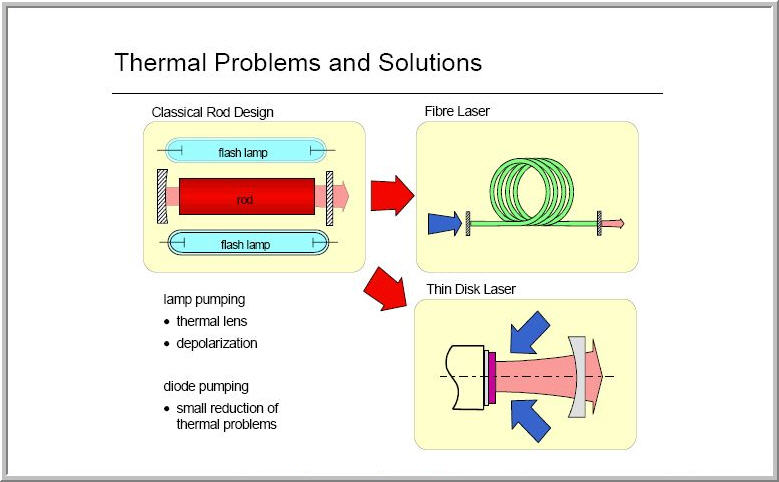
  3. Diode pumped solid state lasers – here you have basically another three options – see slide:
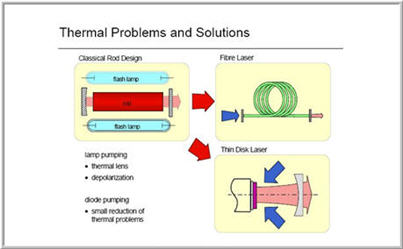
.

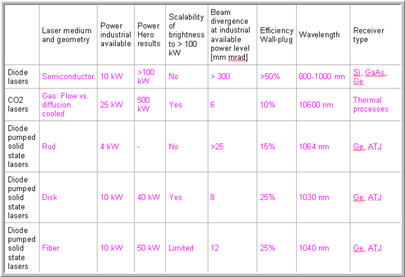
In evaluating the beam sources there are many aspects to consider, for instance: Power, Scalability, Beam divergence, Efficiency, Wavelength, Receiver efficiency.

Here is a compilation of currently relevant laser technologies:
.

Beam quality and Brightness: Power scalability itself is not the important aspect – it is important to be able to increase the power without changing the beam quality of the beam (for TRUE power scalability see: http://arxiv.org/abs/0711.3987v1).  Beam quality is measured as half the beam divergence times the beam radius (units: mm mrad) and tells you for a given beam diameter the divergence of the beam. Beam quality cannot be improved using passive optical elements without reducing the power of the beam. In other words: The brightness (Power per steradian) of a beam source cannot be increased using passive optical elements.  This is VERY important for the space elevator, since we want to shoot the beam at a receiver that can be up to 100,000 km away.  Ben tells me, one needs full power on the elevator up to a distance of 6,000km then a portion of the beam is good enough. I have to believe him there. So, taking these numbers you have for instance for the available Disk laser: 10 kW with 8 mm mrad beam divergence with a (hypothetical) laser aperture of 10 m diameter sending the beam space ward (I chose 10m as it represents todays largest optical telescope apertures, for instance Keck Observatory in Hawaii – you need diffraction limited optical performance on the sending end – therefore this seems a good comparison to me).  In this case the beam grows with a divergence of 1.6e-3 mrad (8 mm mrad / 5000 mm) – the radius therefore grows by 1.6mm for every km – 9600 mm in 6,000km distance.  The entire beam therefore has a diameter of 30 m (2 x 9.6m+10m) in 6,000 km distance. That seems quite feasible to me for a space craft as the receiver does not have to be diffraction limited, it only requires the size.

By building more advanced resonators we can filter higher order modes in the disk laser and achieve 12 kW with 1 mm mrad (This is a hero results that was actually achieved in government lab). That already gives us a beam size of 12,4m instead of 30m!

In order to now scale this power to 100 or even 1000kW the thin disk laser gives us several options (from now on I only talk hypothetically and about hero results):

  • We can currently extract 7 kW per disk and can put 4 disks optically in series – that should allow us eventually to achieve 28 kW at 1 mm mrad – putting disk in one resonator in series does not decrease the beam quality.
  • We can wavelength combine at least 4 different wavelength into a 28 kW x 4 = 112 kW of the same beam quality (since you can superimpose beams of different wavelength without deteriorating the beam quality – called wavelength multiplexing).

This gives us – quite feasible in the next 5 years – 112 kW at 1 mm mrad.

If we would now install 10 separate beam stations that would track the space elevator with a gimble system we can achieve 1000 kW beam with TODAYS’ technology!

BUT NOW TO ANSWER YOUR QUESTION:

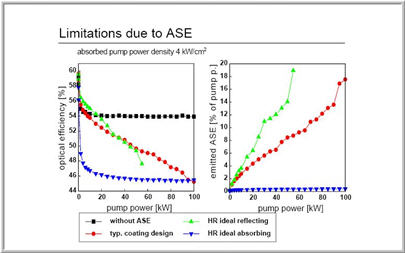
The most important property of the Thin Disk Laser is its ability to be scaled into the 100 kW regime without sacrificing beam quality. This is the major advantage the Thin Disk Geometry has over the fiber geometry for the space elevator project. For an exact definition of power scalability see the following article: http://arxiv.org/abs/0711.3987v1. In this slide you can see that limitations on the scalability of the disk concept to power becomes relevant only at 100 kW per disk or more.
.

Another big obstacle will be the receiver efficiency at the different wavelengths.

  1. Diodes have an advantage since their emission wavelength can be tailored to match maximum quantum efficiency of the receiver material and they are they might even allow the usage of Si as the receiver material. TRUMPF has a diode laser factory near Princeton, New Jersey – I was their GM for three years – and I can see possible advances with super high brightness diodes and dense wavelength multiplexing that might make this another good contender for the beam source of a real elevator.
  2. CO2 lasers emit at 10.6 um – there is no direct conversion using the photoelectric effect feasible – therefore you would need a thermoelectric conversion process, for instance a sterling engine could be used.
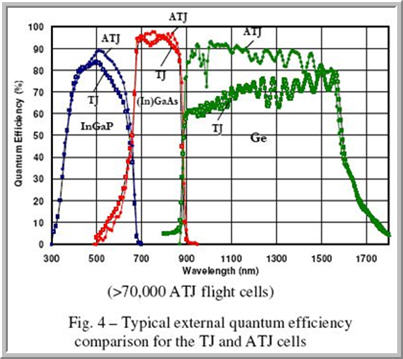
  3. The diode pumped solid state lasers (Disk, Fiber, Rod) emit beyond the fundamental absorption line of Si and therefore need Ge receivers or even ATJ (advanced triple junction – three different receiver types on top of each other) (see the graph below and the white paper link below):
.

Excerpt from http://www.emcore.com/assets/photovoltaics/Emcore_Manuscript_Fatemi_3P-B5-03_WCPEC-3.pdf.

Ben should tell you some more about the finite efficiency of all receivers, as this will provide maybe the THIRD large challenge for the space elevator project – how do you actually remove the excess heat in space that stems from the limited efficiency of any such receiver. And the heat generated may be substantial: Imagine a 1000 kW beam converted with 80% efficiency – you still have to cool 200 kW – how do you do that in vacuum?

[SEB] – What are you offering this year to teams who want to use your equipment?
[HS]– We have promised to offer at least a 8 kW TruDisk laser with 8 mm mrad. This laser is fiber delivered and the teams would have to interface into our safety system and our fiber delivery receptacle. We can provide all the necessary documentation and components for the teams. They will also get enough test time at our or our partners labs.  The project leader for the actual interaction with the teams is Dave Marcotte, our national head of the service and training organization – he is a space enthusiast himself I would like you to ask him directly about the exact deliverables of TRUMPF.
Dave Marcotte [DM]– We look forward to assisting the groups as they progress.  We are estimating the need for 4 “hot laser” testing opportunities for each team at intermediate points in the development process.  We also plan to have a “dress rehersal” before the big competition.   TRUMPF and the teams will need to work together on the “design of test” for each phase.  We have highly knowledgeable people in our Service Group, Product Management and R&D who can be referenced for insight on laser technology, optics, interfacing, safety and integrated systems.

[SEB]– I understand that TRUMPF will be interviewing contestants in this year’s Space Elevator Games at the upcoming Photonics West Trade Show.  What are you going to be looking for?
[DM]– Difficult question.  Basically, I feel key elements of a successful development project are knowledge, organization, attitude and resources.  We will consider the skill set of the group and how the players are presented as a knowledge base.  We will consider the proposed approach to solving the problem, more than the hypothetical solution.  An organized project plan with a best guess on which skills will be utilized is important to pulling the various technologies together into an integrated solution.  Frequently I have seen attitude as a defining difference when presented with development frustrations and failures encountered by individual members and the team.  There is a saying… something like…. “Inspiration vs Perspiration”.  Available resources are unfortunately not connected to knowledge, organization and attitude.  I have seen great guys, who work together seamlessly, but without resources (hardware, software, time, space…) they are starved and unable to demonstrate success.  The resources the group brings to the table will complete TRUMPF’s contribution.

[SEB] – Are you planning on attending the Space Elevator Games this year?
[HS] – Absolutely & I hope to ride the first elevator in 2025.
[DM]– As project manager I plan to be at the games to make sure the laser is transported, installed and operating, with all teams supported.  As for the first elevator ride… I will keep the load balanced, riding with Holger.  🙂

Thank you very much gentlemen for your time.  I look forward to meeting you at the upcoming Games.
The return of MClimber

The University of Michigan’s MClimber, an entrant into the 2006 Space Elevator Games – Power Beaming competition, had the distinction of being the first entrant to make it all the way to the top of the ~50m ribbon.  They were not able to do so in a prize-winning time, but it was an impressive showing nonetheless.  They intended to compete in the 2007 Games but due to various internal issues they could just not get ready in time.

However, they are raring to go in this year’s Games.  I asked their team captain, Andrew Lyjak, for his thoughts on the upcoming Games and received this reply:

Space Elevator Blog [SEB] What factors will be most important to you and the M Climber Team in deciding what power source you’ll be using in this year’s Games?
[MClimber] The MClimber team went through a very rigorous analysis of whether we wanted to proceed with a Microwave or a Laser power beaming system. As you may know, our initial plan was to go with a Microwave system, but due to a variety of factors we have instead proceeded with development of a Laser system. Some of the considerations that lead us to reach this decision were:

1)Team experience with Photovoltaic cells. While we have been using photovoltaic cells to power our climber for the past couple years, Microwave rectenna design was a new field to us. The price of development for similar rectenna and photovoltaic systems was calculated out to be a lot closer than we had originally anticipated and so we chose to stick with what we know, choosing a photovoltaic receiver array over development of a rectenna receiver.

2) Safety considerations: We are a student project, and so when our occupational safety department advised us to stay away from developing a microwave power beaming system, we listened. Lasers are not new to the U of M campus, which made it a lot easier for us to get the go ahead from the safety department for a laser system.

3) Cost: Originally we believed that a laser capable of producing the power that we needed was way beyond our budget, but now we believe that the cost of a laser system is something that we can afford, albeit with a lot of work. Subsequently we now have a full time business team to work with the engineering community and get our name out, and get some sponsors. Our business plan is modeled after the highly successful U of M solarcar team.

[SEB] Will the M Climber Team be attending the Photonics West show and will you be “interviewing” with TRUMPF for possible use of their equipment?
[MClimber] MClimber would like to attend the Photonics West show but does not have the budget at this time to afford the trip. Currently we have plans to talk to TRUMPF in a Detroit location.

[SEB] What are the M Climber Team’s goals for this year’s competition?
[MClimber] MClimber will be demonstrating a rugged climber system in 2008, capable of ascending and descending the 1km tether many times without risk of failure, and will be testing controls systems for the climber. We plan competing in 2009.

[SEB] And one more question.  After M Climber’s great showing in the 2006 competition, we missed you, very much, in the 2007 competition.  What happened – what caused you not to compete last year?
[MClimber] MClimber ran into prototyping issues in the summer, that spiraled out of our control and resulted in us losing too much time to consider competing in October.

Thanks Ted!

Andrew Lyjak
andrew.lyjak [at] gmail.com
(734)604-6163
MClimber team lead
http://mclimber.org

I look forward to their entry this year.  Their 2006 entry was compact, elegant and well-built.  I expect nothing less from this year.  And, as they’ve been down this road before (i.e., they are an experienced team), they will be someone to reckon with in the competition (either this year or next).

Comments from TXL

TXL is a new entrant into this year’s Space Elevator Games Power Beaming Competition.  They are planning on using lasers to power their climber, but not in the “conventional” sense, i.e., beaming the lasers onto photovoltaic cells and running their motors off of the resultant electricity.

I emailed David Nemir, the fearless leader of team TXL to ask him what they planned to do.  Here is his reply:

“TXL Group is a start-up company that was founded in 2007 to refine and produce a high efficiency thermoelectric generation technology that has been under development for several years. Thermoelectric devices generate electrical power from a thermal differential. As TXL migrates from theory to lab to field, we are interested in venues where we can showcase our technology and “make a lot of noise”.

There will be substantial waste heat with any laser powered application and thermoelectric generation represents a means to recover some of that energy. We have been watching the space elevator competition since its inception, with an eye to donating thermoelectric cells to one or more teams in exchange for press and PR coverage. However, at the present time, since TXL does not have a finished product and is not yet prepared to release proprietary information, the company decided to field its own entry.

Our concept is to use a combination of phase change and thermoelectric technology to provide energy to the climber. Maintaining the “cold side” temperature is a major challenge and we will likely use a closed cycle radiative heat exchanger as part of the system.

Because our approach is based upon heat, we are not concerned about the wavelength of the laser and so the 1020 nm laser that Trumpf has so generously offered seems like a good fit. The TXL Team will be attending the Photonics West show and will be talking to TRUMPF at that time.  During the show, we would like to also meet with others in the Space Elevator community. Jan Beck and I will be at the show on Wednesday afternoon and Thursday morning and we can be reached by cell at (915) 449-1907.   Give us a call — we’ll buy the coffee.”

So there you have it.  If you are a member of another Power Beaming team or a member of the press and you are attending the show (I’m jealous if you are), give Jan or David a call.

It occurred to me that some other Climber entries have also tried to power their entry via heat by using Stirling Engines – none successfully so far.  I looked up Thermoelectric Effect in Wikipedia (sorry, Dr. Edwards) and found that it is quite different.  I will be very curious to see how well they do this year.  Good luck to them!

Press Release – TRUMPF to help Space Elevator Games

Here is a Press Release hot off the press and, in light of the series of postings this week I’m doing on the Photonics West show, is particularly timely:

PRESS RELEASE – SPACEWARD 2008 $2M BEAM POWER CHALLENGE: TRUMPF TO SUPPORT COMPETITION TEAMS

Ted Semon
Spaceward Foundation, Mountain View, Calif.
ted [AT ] spaceward.org
(630) 240-4797

2008 Space Elevator Beam Power Challenge Gets Helping Hand.

Mountain View, CA; January 21, 2008 – The Spaceward Foundation is thrilled to announce that TRUMPF will be supporting Space Elevator teams in the upcoming 2008 Space Elevator Power Beaming competition.

TRUMPF will be providing a top of the line TruDisk 8002 laser for use by participating teams, including on-site operation and full safety and engineering support.

The TruDisk laser is a diode-pumped commercial laser source used for industry laser processes such as cutting and welding. It offers exceptional beam quality at high power which easily enables the 1-km range, as well as an innovative fiber-optics based beam distribution system that allows multiple teams to use the same beam source.

For power beaming applications, the beam is expanded over a large area so that its intensity is reduced by several orders of magnitude. The beam is then directed at a photovoltaic panel similar to solar panels used on rooftops as a clean electrical energy source.

Competing teams as well as Spaceward personnel will be available at the TRUMPF exhibit at the Photonics West tradeshow on Thursday, January 24, at the San Jose Convention Center, booth #6130.

Team registration is open, and the latest revision of the competition handbook is available at http://www.spaceward.org/elevator2010-pb.html

Building on the results of the 2007 Space Elevator Power Beaming Challenge, the goals of the 2008 challenge have been set at 1 km height, 5 m/s minimum speed, for a prize level of $2M. An intermediate prize level of $900k is set for a speed of 2 m/s.  Teams that can reach an altitude of 1 km at between 1 and 2 m/s will be awarded a prize of up to $50k.

Illustrations of the 1 km challenge over two hypothetical sites are shown at www.spaceward.org/elevator2010-pb.html, showing the challenge as it would look if held over Meteor Crater in Arizona, and if held over the 2007 venue. The latest revision of the competition handbook as well as a registration link are also available there.

“Power beaming is about transferring power through light beams, and TRUMPF’s know-how allows it to take a leading role in these games” says TRUMPF VP of Laser technology, Holger Schlueter, and adds: “Including myself, many of us here at TRUMPF have never lost our excitement about space exploration, and my organization is thrilled to help shape the future of space travel”.

“We could not have asked for a better contributor” says Ben Shelef, CEO of the Spaceward Foundation. “with a 1-km beam power demonstration, we will have taken the Space Elevator competition to the next level.”

“Personally I’m looking forward to 2008 to be the year Space Elevator research and development really takes off” says Brad Edwards, who’s developed what’s known as the modern Space Elevator design. “with recent results in the fields of Carbon Nanotubes and Lasers, and with progress like we’ve been seeing in the Space Elevator challenge, we expect the perception that the Space Elevator is a near-term project to become more prevalent”.

Clayton Ruzkowski, USST team leader (first place 2007): “I am very proud of how our team preformed at the 2007 competition. Our system has barely scratched the surface in terms of what we can achieve. With TRUMPF’s laser, we expect to be able to greatly increase the speed of our climber.”

BACKGROUND:

The Space Elevator games concentrate on two far-reaching technology concepts that will enable NASA to enhance its space program – power beaming for wireless power transfer, and Nano-materials such as Carbon Nanotubes for strong structures.

Ken Davidian, program manager for Centennial Challenges: “I am excited and impressed with the evolution and level of technical maturity demonstrated by the teams in both the Tether and Beam Power Challenges. Over the past 24 months, individual teams started from scratch, have grown continually, have coalesced into communities, and are on the verge of accomplishing substantial achievements worthy of a Centennial Challenges prize.”

Dr. Bradley C Edwards, the leading Space Elevator researcher and science advisor to the games: “The Space Elevator games, with their emphasis on strong tethers and power beaming, represent the road to building the Space Elevator. We hope their cumulative effect on the engineering community will enable further effort in this direction.”

The Space Elevator is a revolutionary Earth-to-Space transportation system proposed in 1960 by Yuri Artsutanov and enhanced in 2000 by Dr. Bradley Edwards, then at Los Alamos National Labs. The system is comprised of a stationary cable rotating in unison with the Earth, with one end anchored to the surface of the planet and the other end in space. Electric cars then travel up and down the cable, carrying cargo and people.

For more information on the competitions, visit: http://www.spaceward.org, email ted@spaceward.org, or call (630) 240-4797.

Press resources are located at http://www.spaceward.org/press.html

The Spaceward Foundation is a public-funds non-profit organization dedicated to furthering space science and technology in the public mindshare and in educational curriculums.  We believe that expanding mankind’s habitat is essential to its survival, and that the most effective way to induce long-term change is through education.

###

A pdf of the Press Release is available here.

DILAS – The Diode Laser Company

Teams competing in this year’s Space Elevator Games are sure to beat a path to the DILAS booth at the Photonics West Exhibition.  Both USST and Lasermotive, the two laser-powered teams in the 2007 Space Elevator Games, used Laser Diode products from DILAS to power their climber and many more are certainly considering using them this year.

Dr. Georg Treusch from DILAS has kindly consented to answer a few questions for the Space Elevator Blog:

Space Elevator Blog [SEB]:Before being approached by USST and Lasermotive, were you aware of the concept of the Space Elevator?
[Dr. Treusch]: Yes, I have been in contact with Brad Edwards since the Games in Albuquerque.

[SEB]: What do you think of the idea of a Space Elevator?
[Dr. Treusch]:Very challenging to accomplish. In general it is a very good idea and at the same level and beneficial for the world as the solar car competition in Australia which will lead us away from burning our resources.
 
[SEB]: What are you and DILAS offering this year to teams who want to use your equipment?
[Dr. Treusch]: We are talking right now to more than 5 teams about using our new design which has to be finalized after we have solicited all needs from the teams. It will be a 2.5kW base module with all the optics to generate the beam for the 1 km distance and a motorized optic to match the beam to the panel size at various distance.

[SEB]: In the 2007 Games, both USST and Lasermotive used DILAS laser diodes.  For the uninitiated (including myself), what is the difference between a “laser diode” and a “laser”?
[Dr. Treusch]: A laser typically generates one beam with high brightness using a gain medium and two mirrors. A laser diode does the same on a miniature scale. The emitting area is about 1 um high and typically 50 – 200 um wide the cavity length (distance between the mirrors) is about 1 – 3 mm with an output power of 3-5W. To get to more power those emitters are arranged on a laser diode bar (10mm wide, up to 50 emitter) with >100W power. The bars are mounted on high efficient heat-sinks which can be stacked for even more power. By combining multiple emitters the power can be increased but not the brightness. A fiber laser or disk laser with > 1kW power may have a beam quality of less than 3 mmxmrad (beam size x divergence) whereas the diode laser stack has a 10x higher value and therefore a lower brightness.

[SEB]: Telling us as much as you can divulge, how would you compare the approaches between Lasermotive and USST in using DILAS equipment?
[Dr. Treusch]: USST used the approach for an optimized optical system for the maximum distance required and matched the beam size at lower altitudes to the panel with optics.  Lasermotive used stacks with lower brightness and did spread out the beam already at ground level (more optics needed and hard to control and to keep the stacks protected).

[SEB]: I know you attended last year’s Space Elevator Games.  Are you planning on attending the Games this year too?
[Dr. Treusch]: For sure and I will be available at the Photonics West show in San Jose next week at our booth #6073.

Thank you Dr. Treusch!

The Photonics West Exhibition

Beginning this week, the Photonics West Exhibition is going to be held in San Jose, California.  From their website:

“SPIE Photonics West is the most important North American exhibition on optics, lasers, biomedical optics, optoelectronic components, and imaging technologies. Located at the center of the world’s hottest technology market, Silicon Valley, Photonics West is a can’t-miss exhibition.”

I truly wish I could attend, but prior committments prevent me from doing so.  Though I won’t be there, I’m going to do a series of postings about the show, some of the exhibitors and some of the attendees (long-distance blogging as it were).  Ben Shelef of the Spaceward Foundation will be attending and will hopefully send me some photos which I can post too.

Several of the teams who have registered for this year’s Space Elevator Games will be in attendance, visiting the various laser vendors (and other suppliers), looking for a leg-up in this year’s competition.  They will certainly be visiting DILAS, the laser vendor for the two laser-powered teams in last year’s Games (USST and Lasermotive).  They will also be visiting TRUMPF, another laser vendor.  Both vendors are trying to entice teams into using their equipment this year by “stepping-up” with offers of help and support.

The Space Elevator Games have come a long way in just a few short years.  Starting in 2004, running a 25m racecourse with Spaceward-provided, hand-aimed searchlights as a power source, it has now evolved to a competition where the competitors must complete a 1km racecourse using lasers as their power source and with an automated tracking system.

I love it!

Skronk, Greezle and Commander Skippy have much to be concerned with 🙂

But first, an announcement…

Over at the Space Elevator Reference, Marc Boucher announces the launch of:

SpaceRef Interactive Inc. the company that owns and operates this site today launched a new social space news and networking service called On Orbit.

For space elevator enthusiasts and professionals the service includes a Forum dedicated to the Space Elevator. Notable space elevator figures including but not limited to Spaceward’s Ben Shelef and Brad Edwards will be contributing to the forum.

These forums join others already in existence, among them being the Yahoo Groups Space Elevator Forum, the Liftport forums and the National Space Society Space Elevator Chapter.

Correction and future posts…

As has been pointed out to me (several times), the original numbers I posted (here, here and here) for the strength of the Carbon nanotube fibers announced during the recent EuroSpaceward event  are wrong; the correct number should be ~9 GPa – 9 N/tex.  This is still a very significant achievement and if anyone shows up at the upcoming Space Elevator game with a tether this strong, they will blow the house tether completely away.
I will put up a post in the near future about how tether strength is measured and how I went awry.  It turns out to be a bit more complicated than I thought (gee, why I am not surprised?)…

However, for the next week or so, and in conjunction with the Photonics West Trade Show which begins tomorrow, I will be doing a series of post on a) some of the Climber teams who are going to be competing this year and b) TRUMPF and DILAS; two vendors who are really stepping up to further the concept of a Space Elevator.

Stay tuned…

(Homer pix from here)

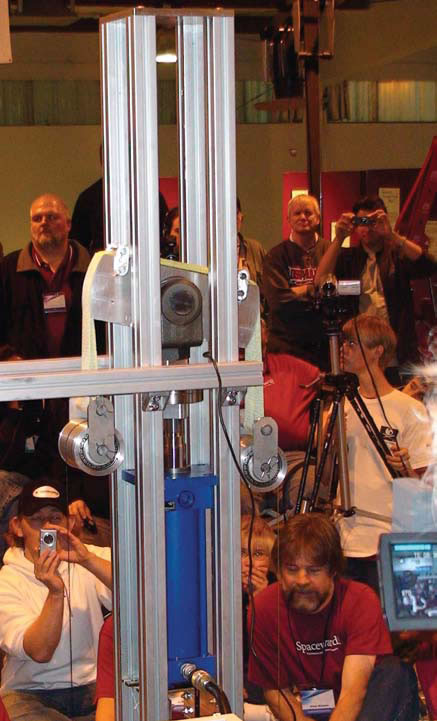
“Building a tug-of-war machine”

In the current issue of Machine Design, there is an article about building the tether-pull machine which was used in the most recent Space Elevator Games.  It’s an interesting article – here’s an excerpt:

“The tether machine is a rectangular box about 12-ft long and 18-in. high on each side. Using bolttogether connectors from Bosch Rexroth Linear Motion and Assembly Technologies, Buchanan, Mich., the tether pull structure easily assembles without special tools or skills. The extruded aluminum framing looks clean and attractive without painting or other finishing. The team could also choose from numerous accessories to extend the machine beyond a simple frame and base to a complete multifunctional structure. And, every aluminum structuralframing component is reusable, which made it simple for the team to make changes as designs developed.

You can access the entire article here.

The picture is from the website and was taken by yours truly – it shows the defeated DeltaX tether draped over the tether-pull machine while the tether from Astroaraneae is still wrapped around the rollers.

Spaceward Press Release

The Spaceward Organization today sent out a Press Release detailing the goals of the 2008 Space Elevator Games Power Beaming competition.  Those of you who pay attention to the Spaceward website or read this blog will already know what they are 🙂

PRESS RELEASE – SPACEWARD 2008 $2M BEAM POWER CHALLENGE: GOALS ANNOUNCED

Ben Shelef
Spaceward Foundation, Mountain View, Calif.
ben [at] spaceward.org
(650) 793-4987
http://www.spaceward.org/PR-2008-001.html (includes support images)

2008 Space Elevator Beam Power Challenge – Goals Announced

Mountain View, CA; January 16, 2008 – The Spaceward Foundation announces the goals for the 2008 Space Elevator Power Beaming Challenge.

Building on the results of the 2007 Challenge, the goals for 2008 have been set at 1 km height, 5 m/s minimum speed, for a prize level of $2M.

An intermediate prize level of $900k will be given for a speed of 2 m/s. Additionally, teams that can reach an altitude of 1 km at between 1 and 2 m/s will be awarded a prize of up to $50k.

The 1-km climb will be supported by a unique pyramid-anchored balloon system, providing the teams with a stable tether to climb on. Illustrations of the challenge over two potential sites are shown at www.spaceward.org/elevator2010-pb.html, showing the challenge as it would look if held over Meteor Crater in Arizona, and if held over the 2007 venue.

Team registration is open, and the latest revision of the competition handbook is available at the above web page as well. The venue has not been selected yet, and the tentative date for the competition is the week of September 8th, 2008.

Starting this year, TRUMPF, Inc. has joined the games and will be supporting teams with Laser hardware and know-how. More details will be made available at the upcoming Photonics West tradeshow in San Jose, January 22-24.

“The 1 km challenge really takes us to next level” says Ben Shelef, CEO of the Spaceward Foundation. “The point of power beaming is that it can work over any distance, and this challenge will illustrate the promise of this technology.”

The Spaceward Foundation is a 501(c)(3) public funds non-profit organization (EIN: 34-1997639) dedicated to the advancement of space technology in education and in the public mindshare. For more information, please visit http://www.spaceward.org

“Personally I’m looking forward to 2008 to be the year Space Elevator research and development really takes off” says Brad Edwards, who developed what is known as the modern Space Elevator design. “with recent results in the fields of Carbon Nanotubes and Lasers, and with progress like we’ve been seeing in the Space Elevator challenge, we expect the perception that the Space Elevator is a near-term project to become more prevalent”.

BACKGROUND:

The Space Elevator games concentrate on two far-reaching technology concepts that will enable NASA to enhance its space program – power beaming for wireless power transfer, and Nano-materials such as Carbon Nanotubes for strong structures. Total prize money provided by NASA for the games is $4,000,000.

Ken Davidian, program manager for Centennial Challenges: “I am excited and impressed with the evolution and level of technical maturity demonstrated by the teams in both the Tether and Beam Power Challenges. Over the past 24 months, individual teams started from scratch, have grown continually, have coalesced into communities, and are on the verge of accomplishing substantial achievements worthy of a Centennial Challenges prize.”

Dr. Bradley C Edwards, the leading Space Elevator researcher and science advisor to the games: “The Space Elevator games, with their emphasis on strong tethers and power beaming, represent the road to building the Space Elevator. We hope their cumulative effect on the engineering community will enable further effort in this direction.”

The Space Elevator is a revolutionary Earth-to-Space transportation system proposed in 1960 by Yuri Artsutanov and enhanced in 2000 by Dr. Bradley Edwards, then at Los Alamos National Labs. The system is comprised of a stationary cable rotating in unison with the Earth, with one end anchored to the surface of the planet and the other end in space. Electric cars then travel up and down the cable, carrying cargo and people.

For more information on the competitions, visit: http://www.spaceward.org,
email ted@spaceward.org, or call (630) 240-4797. Press resources are located at
http://www.spaceward.org/press.html

The Spaceward Foundation is a public-funds non-profit organization dedicated to furthering space science and technology in the public mindshare and in The Spaceward Foundation is a 501(c)(3) public funds non-profit organization (EIN: 34-1997639) dedicated to the advancement of space technology in education and in the public mindshare. For more information, please visit http://www.spaceward.org educational curriculums. We believe that expanding mankind’s habitat is essential to its survival, and that the most effective way to induce long-term change is through education.

###
The Spaceward Foundation is a 501(c)(3) public funds non-profit organization (EIN: 34-1997639) dedicated to the advancement of space technology in education and in the public mindshare. For more information, please visit http://www.spaceward.org

Year-end update from the Spaceward Foundation

This morning, I received the following email from Ben Shelef at the Spaceward Foundation, wrapping up 2007 – a great year for the Space Elevator community.  If you want to get on the Spaceward Foundation’s email list, just visit them at their Homepage and sign up.

Spaceward Foundation News Bulletin


Newsletter #4 – December 31, 2007


Hello folks, and Happy New Year!It’s been a while since our last newsletter – seems that whenever something’s going on in Space Elevator land, we’re always too busy to write. 🙂 Two months after the 2007 games, this is a good time to briefly reflect on this past year, and update you on our next steps for ’08 and beyond.In this newsletter:

  • A look back at 2007
  • A preview of our plans for 2008
  • A new partner
  • Carbon Nanotube news

2007:For those who missed the real-time action, the official wrap-up of the 2007 Spaceward Games is posted online at www.spaceward.org/games07Wrapup.html. As usual, you can re-live the day-by-day coverage at the archives at Ted Semon’s Space Elevator Blog and Marc Boucher’s Space Elevator Reference.The most significant result of the 2007 games, however, is not measured in units such as kilograms or in meters per second. What we saw in 2007 was a huge leap in the level of technology fielded by the teams. In particular, our two laser-based teams, USST and LaserMotive, designed and built complex advanced systems worthy of an aerospace project, and have acquired a set of capabilities that attracted industry interest to our competition. In terms of fulfilling the charter of the games, we could not have asked for more.Looking back, you may remember that Space Elevator games did not exist before 2005. Unlike our role models – Solar car races and rocketry clubs, we did not have a rich tradition of games spanning tens of years to rely on. We started practically from scratch, and we are immensely proud of how our teams have grown.

Having wrapped up the games, our next order of business was charting the course for 2008. The immediate choices we looked at were keeping the challenge goals the same as in ’07, doubling the speed or height requirements, or doubling both. However, after gathering feedback from existing and potential teams, the Space Elevator community, and relevant industry experts, we decided to go for something a bit more grandiose…


2008:In broad strokes, the goal of the Space Elevator games is to bring the Space Elevator closer to reality. The goal of the power beaming challenge is to promote power beaming technology. We think that the time is ripe now to move the competition to the next level, addressing real-world power beaming scenarios where the minimum requirements for such systems start at the km range and kWatt power levels.For the 2008 power beaming challenge, therefore, we’ve chosen a climb height of 1 km.There’s a drum roll missing here. 1 km is the height a jetliner is at when the cabin crew asks you to put your laptop away… To show what a 1 km tall race track looks like, we’ve posted a preview at the Power Beaming page. (The location shown is hypothetical, of course!) Also note the comparison to the 2007 games – those were held inside the small orange circle just below and to the left of the center-image.

To match the change in scope, we’re also increasing the available prize money. As a matter of fact, we will be making the entire $2,000,000 available this year, depending on the speed of the climb. For 2 m/s, we’ll be offering the originally scheduled $900k prize, but if a team can reach 5 m/s this year, it will receive the entire $2M purse. If not claimed, we’ll keep the prizes and challenge the same for 2009.

The racetrack we’re planning, based on a pyramid-tethered balloon, will be the tallest such pyramid ever flown. We’re working with industry experts to set this up, and will keep you updated. This is very exciting for us, since this architecture is extendable to 10 km as well – almost a percent of a percent of the real Space Elevator…. In all seriousness though, while obviously all Earth-bound Space Elevator models are vastly shorter than the real thing, as far as reproducing the look-and-feel of a Space Elevator, this setup will go a long way towards demonstrating what the SE will be like.

Registration for the 2008 games is now open, and the first teams have already started working on their entries.


TRUMPF, Inc.We are very excited to announce the participation of TRUMPF as a sponsor for competition teams. TRUMPF will provide their top-of-the-line laser to qualifying teams to be used as the beam source, easily enabling 1 km power beaming.


CNTs:Finally, last but definitely not least, we’d like to share this exciting bit of news about Carbon Nanotube tethers: About a month ago, as reported at the Space Elevator conference in Luxembourg, a team from Cambridge University produced the first macroscopic carbon fibers that exhibited the kind of strength we were all expecting so see. These fibers, up to 1 mm long, clocked in at 10 N/tex, or about a fifth of what we need to build the Space Elevator (see here for details) We’re looking forward to seeing this team and other CNT labs entering the tether competition next year.


So with this happy bit of news we’ll sign off for this newsletter.
 Have a happy new year!
   The Spaceward Team.


The Spaceward Foundation is a 501(c)(3) educational non-profit dedicated to furthering Space exploration in educational curriculums and the public mindshare – http://www.spaceward.org.


Mobile Suit Gundam

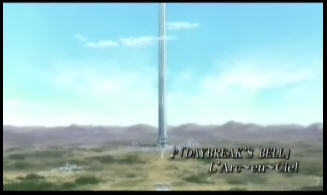
Akira Tsuchida, team leader of E-T-C, emailed me to let me know about a new animation series, Mobile Suit Gundam, which is now being broadcast in Japan on Saturday evenings at 7:30pm.  The plot centers around three space elevators (one owned by the Americas and Japan, one owned by Russia, China and India and one owned by Europe and Africa).  The series website has a plot summary, in Japanese of course.  When you plug the plot summary into AltaVista’s Babel Fish Translator, you get the following:

“Western calendar 2307. The fossil fuel was depleted, but the mankind was obtaining the new energy which is substituted to that. 3 these enormous tracked elevators and the large-scale solar power generating system which accompanies that. But, those where benefit of this system can be obtained were just the large country and that ally of part. Three superpower groups which own three tracked elevators. The United States of America was centered, ‘ the union ‘. China, Russia and India were centered, ‘ mankind reformist union ‘. Europe was centered, ‘ AEU ‘. Each superpower group because of dignity and prosperity of oneself, continues the great zero-sum game. So, being 24 centuries, the mankind was yet can become one……. In the world of the fight which does not have such end, the private armament organization which puts out “the elimination of the war with military force” appears. As for their names which own mobile suit “Gundam”, ??????????. Military intervention to all the war behavior which are according to Gundam starts.”

Akira sent me another translation of the plot summary:

“2037 in Christian era.

The human race was obtaining new energy that took the place of it though the fossil fuel dried up. Large-scale photovoltaic generation system according to tree huge orbit elevator. However, it was only a part of large country and the ally that obtained the favor of this system.

Three super power groups that own three orbit elevators.
 ‘Union’: USA, North and South America countries and Japan,
 ‘Human race reformation league’: China, Russia, and India
 ‘AEU’: Europe and Africa
 
Each super power group continues a considerable zero-sum game with prestige by yourself for prosperity.
The human race had it was not possible to finish uniting into one yet though it became a century the 24th so …….
A private, armed organization to which “Extermination of the war by military power” hangs appears in the world of such an endless fight. Names of men who own movable suit “Gundam” are Sorestalbeing.
 
The military power intervention to all hostilities by Gundam starts.”

There is also a website which has brief snippets of some of the episodes.

The heros seem to be a cross between the Power Rangers and the Transformers.

So, if you have access to Japanese TV, enjoy!

Thanks Akira…

(The pictures are taken from the video clips.  Click on them for a slightly larger version or visit the website to see them in action.)

30DEC07 – Correction.  I received two email comments on this post from “K Elmer” who informed me that “Just to be correct, the name is Mobile Suit Gundam 00. Mobile Suit Gundam was the first series in the franchise in 1979.”  There is a Wikipedia entry for this particular series and it contains a much more coherent description of it’s plot than I provided.  Just to give you a level of detail contained in this Wikipedia entry, here is an excerpt:

“Mobile Suit Gundam 00 follows four mobile suit pilots termed Gundam Meisters ( ????????? Gandamu Maisut??), sided with Celestial Being. The protagonist is 16-year old Setsuna F. Seiei (???F??????), a quiet, taciturn young man who grew up in the Kurdish Republic, and a Gundam Meister for two years. He pilots the GN-001 Gundam Exia, a high mobility mobile suit effective in melee combat.”

I had no idea… 🙂

Thanks K Elmer!

New life for NIAC?

I have written several posts (most recently, here and here) about the NASA Institute for Advanced Concepts (NIAC) and it’s struggle to stay alive.  At the end of last August, NASA had killed this agency, citing budget issues.

From this posting by Leonard David at LiveScience, it appears that at least some people in the House Appropriations Committee think this may not have been such a good idea.

Quoting Mr. Leonard’s post: “From the report, the committee has expressed concern that NASA has decided to close the NASA Institute for Advanced Concepts ‘without a rigorous assessment of the Institute’s merit.'”

I can only say “Amen” to that…  I’m sure that both NASA and the Appropriations Committee have a gazillion special interest groups yammering at them about how “their project” has to be funded.  But NIAC was underwriting, and leveraging, an investment in the future, real “blue-sky” stuff.  Their investment into Dr. Edwards research was a perfect example.  Anyone who attended or paid attention to this year’s Space Elevator Games and saw not only a carbon-nanotube tether, but also multiple laser-powered climbs, knows that this is an idea whose time is rapidly approaching.  And the NIAC grant to Dr. Edwards helped make it happen.

The final NIAC report (available here) makes for very interesting reading.  The NIAC “Funding Tree” (shown as a graphic at the top of this post – click on it for a larger version) shows how NIAC-distributed funds leveraged private-sector funds.  The most successful of these, again according to this graphic, was Dr. Edwards work with the Space Elevator concept.  NIAC summarized it’s funding of Dr. Edward’s research as follows:

“This effort sparked the creation of numerous businesses and attracted funding with a particular emphasis on the development of carbon nanotube materials. Space Elevator has been the focus of numerous prize competitions, including NASA’s Centennial Challenges program. Additional support: at least $8.5 million. Future impact: billions if not trillions of dollars in launch savings relative to current methods. As one NIAC Fellow explained: “The Space Elevator would change everything.”

I love that last line; “The Space Elevator would change everything.”  It would, it certainly would.

If you have a member of the Appropriations Committee from your state (and better yet, from your district), write him/her a letter and let them know what you think.  Compared to the $555 billion dollar appropriations bill which was just signed into law, the total NIAC budget of $5.9 million (over 9 years) is not even a rounding error.

Planning underway for 2008 Space Elevator Games – Part 2

In my last post on this subject, I wrote about the changes that were being implemented for the upcoming Space Elevator Games.  They are:

  • The climb will now be one full kilometer (10 times what was required in the 2007 Games).
  • There will now be two levels of prizes: $900,000 (for a climb averaging 2m/s and $1,100,000 for a climb averaging 5 m/s).

I also wrote about how a couple of laser-supply companies (TRUMPF and DILAS) are now working with Spaceward to help lower the costs of the lasers which will be necessary to power a climber a full kilometer up from the ground.

In this post, I want to talk about the raceway itself.  How do you build a one kilometer vertical raceway system, a system which will have to a) support the raceway itself, b) support the climber, c) be able to lower “stuck” climbers back to the ground and d) be undamaged by stray laser beams that may occur?  And, once you have this raceway system, where do you put it?

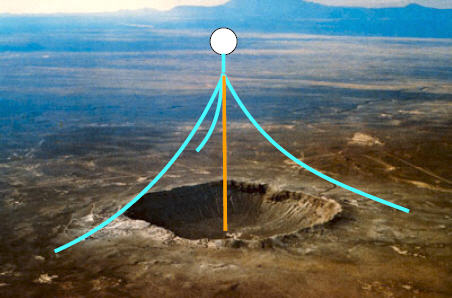
The first part of this question, how do you build this raceway, has a tentative answer.  Spaceward is aiming towards a balloon-supported system with a raceway made out of 3/16″ or 1/4″ twisted steel cable.  As was all too obvious last year, Spaceward needed to find something much stronger than the ribbon they used in the previous two competitions (and which broke a couple of times last year).  The steel cable is more than strong enough, but will require that the Climbers use a different mechanism to grip the raceway than they did before.  The balloon would be tethered with (probably) three cables.  The raceway cable itself would travel from a ground point (centered between the three tether cables) up to the balloon.  Fears of the laser hitting the balloon and causing it to burst are unfounded because most of the time the wind will be blowing the balloon and moving it and, consequently, the cable system holding it up and the raceway itself.  This will cause the raceway cable to droop some and so a laser aimed at a climber on the cable will not be pointed directly at the balloon.  When the climber gets very close to the top, a small shield under the balloon can shield it.  It may also turn out that the balloon itself is “invisible” to the lasers in the 800-1000 nm range, rendering the whole issue moot.

So, we have a tentative solution to building a one km raceway.  Now, where do you put it?  This becomes a very big system.  The diameter of the circle created by the tethers is on the order of two-three kilometers; i.e. nearly two miles.  To get an idea of how big that is, Spaceward has posted on their site (and also shown on this post) a picture of how big the raceway system would be in respect to Meteor Crater in Arizona (as an aside, wouldn’t that be the coolest place for a racecourse ever?).  This is where we are now; Spaceward is actively looking for a site to hold the 2008 Competition.  On their 2008 Competition web page, they list the following sites they are considering:

  • Davis County Fairgrounds, UT (where the 2007 Games were held)
  • Meteor Crater, AZ (pictured)
  • Bonneville Salt Flats, UT
  • Albuquerque Balloon Festival, NM
  • White Sands, NM
  • Rockets Sites:
    Brothers Rocket Site, OR
    Black Rock, NV
    Jean Dry lake, NV
    Mansfield, WA
    Tripoli Idaho Swan Falls, ID
  • NASCAR raceways:
    (must be away from airports!)

So, if you know of any sites that might satisfy the requirements (Sites must be able to accommodate a 1 km tall tethered balloon pyramid, offer convenient logistics support, and be relatively easily accessible. Natural landmarks get extra points.) please let Ben Shelef at Spaceward know!  You can contact Ben via email at ben [at] spaceward [dot] org.

Planning underway for 2008 Space Elevator Games

For the past several weeks, the Spaceward Foundation has been actively working to set up next year’s Space Elevator Games.  As with the previous games, the goals in the Climber / Power-Beaming competition continue to get more ambitious.  Two major changes for the 2008 Games are:

  • The climb will now be 1 kilometer (10 times what was required in the 2007 Games).
  • There will now be two levels of prizes: $900,000 (for a climb averaging 2m/s and $1,100,000 for a climb averaging 5 m/s).

The magnitude-sized increase in the length of the Power-Beaming climb will now almost certainly mean that only laser-powered entries will be able to successfully compete.  We only had two such entries, USST and Lasermotive, in the just-completed games.

One of the reasons why only two teams took this route this year is that Lasers are EXPENSIVE – just ask those teams that used them in the last competition (or looked at them and reluctantly went to some other power source because they couldn’t afford them).  And a laser that will power a climber a full Kilometer will have to be much more powerful than the ones used for the 100 meter climb this year – and that means even more expensive.

Spaceward has been talking with several different laser manufacturers to see if they would support the competition.  At least two companies, TRUMPF and DILAS, have responded.  This is from an email sent out earlier this week from Spaceward’s Ben Shelef:

“TRUMPF’s involvement is now official. They will support up to 4 groups with a laser on-site, plus testing at their factories. This is not strictly on a first-come basis, but we’re going to start forming these relationships now. This setup is capable of generating a 40 cm spot size, and the wavelength is 1040 nm. I want to stress (yet again) that they provide the light source delivered through an optical fiber – you have to build the rest of the optics. Also, travel and shipping, insurance, etc – this is not an all-expenses paid environment.

DILAS is offering an aggregeatable module system for sale which includes a light source and collimating optics and projects a 1 meter diameter spot at distances of up to 1 km. This is a different concept – you buy it and take it home with you. The cost is $10-12 per watt, and comes in 2500 Watt modules. We are allowing these modules to be shared as well. DILAS can supply a variety of wavelengths between 800 and 980nm.

From Spaceward’s point of view, this is a very good scenario – at least two viable and technically different baseline options.”

This should advance the technology even more quickly as it should allow multiple teams to create a laser-powered entry.

I looked at the web sites for both TRUMPF and DILAS.  The TRUMPF site mentions it’s Laser Community, a magazine it produces devoted to the laser field.  In the current issue, they make the following statement on the last page of the magazine: “100,000 Kilometers – Across this distance, laser beams may one day power the motors of the so-called Space Elevator.  For now, this way from the Earth to Outer Space is still a technical dream.  If and when it is ever realized is written in the stars.”  Sounds like these guys ‘get it’.

As noted earlier, there will be two levels of prizes, one of $900,000 for team(s) meeting or exceeding 2 m/s and one of $1,100,000 for team(s) meeting or exceeding 5 m/s.  This means that a prize purse of two MILLION dollars will be available for this competition.  There will also be cash prizes awarded for teams that average at least 1 m/s for the Kilometer-length climb – these prizes will be taken out of the two million dollar purse.

The formula for awarding these prizes, as well as all of the other proposed rules for the 2008 competition, are contained in the preliminary rulebook available here.

Next up – how and where do you set up a 1 Kilometer raceway?

90 Orbits and counting…

Happy 90th Sir Clarke!!  Thank you for the inspiration and the hours and hours of reading pleasure you have given me.  I hope that you get to see a real Space Elevator being built…

[youtube]http://www.youtube.com/watch?v=-OEQryeDuh0[/youtube]

Sir Arthur C. Clarke’s upcoming 90th birthday…

Today I received the following email from Thilna Heenatigala, the General Secretary of the Sri Lankan Astronomical Association:

“Fellow Earthlings,

Sixty two years ago Arthur C. Clarke of the British Interplanetary Society sent a letter to the editor titled Peacetime Uses for V2 which was published in the 1945 February issue of the Wireless World magazine suggesting the use of Geostationary Satellites for the instant global communications. Quoting,“I would like to close by mentioning a possibility of the more remote future–perhaps half a century ahead.  An “artificial satellite” at the correct distance from the earth would make one revolution every 24 hours; i.e., it would remain stationary above the same spot and would be within optical range of nearly half the earth’s surface. Three repeater stations, 120 degrees apart in the correct orbit, could give television and microwave coverage to the entire planet.”

Today, the Clarke Orbit has over 330 satellites. Sir Arthur C. Clarke, a science-fiction author, inventor, and futurist, simply a greate mind celebrates his 90th birth anniversary on 16th of December, 2007.

In 1959, he founded the Ceylon Astronomical Association (now known as Sri Lanka Astronomical Association). As the current General Secretary of the Association, I’m honored to run an association founded by him. And as a big fan of his writings and admirer of his work, I have put up a blog where every one could wish him for his 90th birth day.If you are a friend, colleague, fan or simply an earthling who admires work of Sir Arthur Clarke, please write your greetings and good wishes on the blog. Please forward this message around and publish in your website/ magazine/ paper/blog etc… if possible.Let us wish together a healthy and a long life for Sir Arthur.Post your greetings and wishes on http://SirArthurCClarke90.blogspot.com

Regards,

Thilina Heenatigala
General Secretary
Sri Lanka Astronomical Association
E-mail: thilina_atn@yahoo.com
URL:     http://aalk.lakdiva.net
http://thilinaheenatigala-astronomy.blogspot.com
Phone:    +94-716245545″

Readers of this blog know that I am a huge fan of Sir Arthur C. Clarke.  I think I can honestly say I’ve read everything he’s ever written for public consumption, both fiction and non-fiction.  His book The Fountains of Paradise was what introduced me to the concept of a Space Elevator and is probably the main reason this blog exists.  One of my fantasies is that someday he would attend some Space Elevator Function (the Games, a Workshop / Seminar, etc.) and that I would be attending it too and would have a chance to meet him.

Please visit Thilna’s birthday blog and post a birthday greeting to Sir Clarke.  Without him, the World would be a much poorer place.

(The picture thumbnail shown is of Sir Clarke with Yuri Artsutanov, the father of the Space Elevator concept.  I don’t know who to give credit to this photo to, but I found it here.  Click on it for a larger version.)

What do silkworm moths, mice, tritons, lizards, snails and cockroaches have in common?

In April of this year, I posted about a couple of tether launches scheduled for later in the year.  One was from Tethers Unlimited, home of the esteemed Robert Hoyt (documented here, here, here, here and here.)

The other tether launch I mentioned was the 2nd effort from the Young Engineers Satellite group and was so labeled the YES2 mission.  The European Space Agency (ESA) described this mission as follows:

“YES2 was one of the ESA-provided payloads on board the Foton-M3 microgravity mission. The Foton spacecraft and the piggybacking YES2 payload were launched by a Soyuz rocket from Baikonur, Kazakhstan, on 14 September. The YES2 experiment was installed on top of the battery pack of the Foton-M3 capsule. The 6 kg Fotino capsule was attached to the end of a 0.5 mm thick, 31.7 km long tether. Once the tether unwound and deployment stopped smoothly at 30km, the Fotino capsule was to be automatically released by a pyrotechnic device and sent on a return path to Earth’s surface through the atmosphere and landing safely by parachute in a pre-determined location. The objective was to demonstrate the ‘SpaceMail’ concept of delivering parcels back to Earth from an orbiting spacecraft using only a tether.”

This video on YouTube gives a good explanation / animation of what the mission was supposed to do.

[youtube]http://www.youtube.com/watch?v=7IN7mdU_QU4[/youtube] 

This YouTube video, originally from Russia today, shows the launch and discusses the mission in some detail.

[youtube]http://www.youtube.com/watch?v=y4SMv7kkJs0&[/youtube]

.

Several videos of this launch and the events leading up to it are posted on the ESA website here.

In September of this year this mission was launched.  After the deployment of the YES2 satellite, problems occurred and the mission was reported to have failed.  Supposedly only part of the tether had deployed.  Several news stories covered this event:

From Kommersant, Russia’s Daily Online (this story contains the answer to the trivia question I posed in the title of this post).

From Wired Science.

From Russia Today.

Recently, however, it was reported that new data indicates that all 31.7km of the tether WAS deployed.  The YES2 satellite may have even landed but this is not yet known for sure.  It would be way cool if it did…

The blog / updates on the YES2 website are very interesting (not to mention voluminous).

Incidentally, in this Associated Press release, it was reported that the tether was “made of Dyneema, a substance that the European agency said is the world’s strongest fiber and is used by kite surfers.”  Looking this up in Wikipedia(sorry Dr. Edwards), one finds that this material is very similar to Spectra, and is made up of extremely long chains of polyethelene held together by Van der Waals bonds (suspiciously similar to the hoped for carbon-nanotube fibers to be produced in the very near future).

(Photo credit: Fabio De Pascale – no larger version available)

Photos from the EuroSpaceward Tether & Climber Workshop

Several days ago, The Space Elevator Reference published a short story about the EuroSpaceward Tether & Climber Workshop which was held in Luxembourg the week before last. 

Markus Klettner has kindly emailed me the links to photographs taken during the Workshop.  The links are here and here.  In this post, I’ve selected 10 of the more than 50 photos from these links.

Brad Edwards

.

.

.

.
Ben Shelef

.

.

.

.
Bryan Laubscher

.

.

.

.
Dr. Georg Treusch

.

.

.

.
Michel Benoit

.

.

.

.
CNT array samples from the lab of Dr. Shanov

.

.

.

.
Prof. Vesselin Shanov

.

.

.

.
Dr. Marcello Motta

.

.

.

.
Prof. Vesselin Shanov with USST’s Clayton Ruszkowski

.

.

.

.
Markus Klettner

.

.

.

.

“Rather a special sort of smoke…”

This is courtesy of Akira Tsuchida, team leader of E-T-C.

He sent me a link to a BBC video clip, showing the new 20 GPa nanotube fibers being created, an audio clip giving a short explanation of how it’s done and another audio clip explaining why these are suitable for body armor.

All three clips can be found here.

Thank you Akira!

(The picture thumbnail is a snapshot from the BBC Video clip – click on it for a slightly larger version)

04FEB2008 – Correction.  The best fiber strength was measured at 9 GPa, not 20 GPa as I (and others) initially reported.

Kansas City Space Pirates appear on their local ABC Affiliate

Brian Turner, captain of the Kansas City Space Pirates, sent me this link to the team’s appearance on their local ABC affiliate this morning.
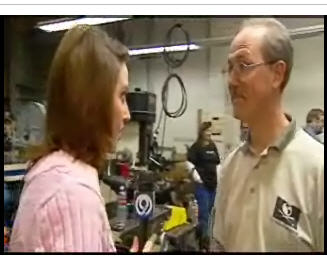
Brian said in his note:

Here is a clip form this morning. The actual coverage got cut short by some technical glitches and a traffic accident story that was more important.

I hope everyone had fun.

We saw a quick demo of their Climber (the “Jolly Roger”), their winning entry in this year’s Light Racers Competition (I absolutely loved Quinn’s explanation of how it worked) and, of course, a demo of Brian’s RC controlled lawn mower.  We were also introduced to many of the team members.

The clip is a little over 4 minutes long.

(Click on the picture thumbnail for a slightly larger version)

2008 Space Elevator Calendars for sale at SpaceRef.com

Marc Boucher, of SpaceRef.com, The Space Elevator Reference and a bunch of other places (and who I wrote about previously here) has come up with a great idea – a 2008 calendar containing photos he took of the recently completed Space Elevator Games.

You can read about it and order it here – what a great idea – especially with the holidays coming up!  I’m going to be ordering mine today.

PS – My favorite picture is April – it’s the shot with the Alien Ship in it…

(Click on the thumbnail for a slightly larger picture of the calendar cover)

More on 20 GPa carbon nanotubes…

More from Dr. Edwards about this development:

It has not been released in print yet because it is coming out in Science next week – just verbal so far. I can’t even get a copy of their presentation until next week.

The details are that they are making threads with 20 GPa but not consistently – 25% of the time or about that. It is also part of a very steady, consistent increase that they have had in their material over the last 4 years. Their process is one where the CNTs are grown in a furnace without a substrate and pulled out on a spool from the bottom.

And the MIT-DeltaX team has this to say about it on their blog:

Recently, Dr. Alan Windle at the University of Cambridge announced the development of 20 GPa yarns derived from nanotubes. These materials are produced from nanotube yarns and contain graphitic hyperfilaments composed of nanotubes, which exhibit strengths comparable to an individual nanotube but over macroscopic length scales.

We have been working on the production of these materials for some time now as well. Independently our team had developed the same processing technique Dr. Windle is using, but with our own twist.  But we are not only producing yarns, but also ribbons. More on this soon…

Exciting times, to be sure.

Incidentally, I’ve updated the link to the DeltaX website on this blog’s sidebar…

04FEB2008 – Correction.  The best fiber strength was measured at 9 GPa, not 20 GPa as I (and others) initially reported.

Breaking news…

I have been corresponding with Dr. Brad Edwards who attended the recent EuroSpaceward “Space Elevator Climber and Tether Workshop”.  He sent me the following news (and I quote):

“The conference in Luxembourg went very well – including an announcement by Cambridge of 20 GPa CNT threads.”

This rocks, of course, and I am working on getting additional details.  There is nothing yet about this on the Cambridge website, but I’m assuming there will be soon.

Stay tuned…

04FEB2008 – Correction.  The best fiber strength was measured at 9 GPa, not 20 GPa as I (and others) initially reported.

I’m back…

I’m happy to report that the eye surgery seemed to go well.  The surgeon did a post-op with me today, removed the bandage and patch, and reported that all looked good at this point.

It’s so wonderful to be able to see out of my right eye clearly and not through a fog.  The night vision in my right eye is still not what it should be, but my right-eye pupil is about the size of a dot.  The doctor tells me that will change in the next day or two.

Thank you to everyone who wished me will, either via a comment, or in an email or with their thoughts – it was much appreciated.

And, now back to the show…

Marc Boucher appears on The Space Show

Almost everyone who is interested in Space Elevators and is at all Internet-savvy knows the website The Space Elevator Reference.  This site is the original Space Elevator site and remains a “must-visit” for anyone who is interested in the subject.

Marc Boucher is the author of this site (as well as others, most notably, IMHO, SpaceRef.com – a site I’ve written about several times before – if you’re not already signed up for their daily alerts/news, you should be).  One of the many good things which happened to me at the recent Space Elevator Games was the opportunity to meet and work with Marc.  He and I had corresponded a bit over the past year, but I’d never met him before this year’s Games.

Marc was the person responsible for the webcams at this year’s Games (thank you Marc) as well as a number of notable photos posted on the Space Elevator Reference website.  If you haven’t visited this site and seen Marc’s coverage of the games, you’re missing a treat.

He was also interviewed yesterday (the 30th) by Dr. David Livingston on the Space Show.  Dr. Livingston does a very thorough job on biographies – here is an excerpt from Marc’s bio…

“Marc Boucher is an entrepreneur, technologist, explorer and bon vivant. He came into his own when spurred on by his brother, he decided to start his first business in 1991 and hasn’t looked back since. Boucher is the founder of aTerra Technologies, co-founder of SpaceRef Interactive, co-founder of the Mars Institute and has ideas about starting other new ventures. aTerra Technologies focuses on Internet technologies, in particular data gathering and aggregation, vertical search, web development and is best known for developing original content properties and web crawlers…In June of 2000 SpaceRef announced it had licensed SpaceRef content to the Discovery Channel. Today SpaceRef is one of the leading online space news sites comprising 14 web sites in its network and growing. SpaceRef has also begun to modestly sponsor research by first donating the Arthur Clarke Mars Greenhouse to the Haughton-Mars Project (HMP) in 2002. In addition SpaceRef has been managing webcams for the HMP since the summer of 2000. Boucher himself has had the pleasure to participate in the HMP as an Exploration Research Co-Investigator for five field seasons and has been to the high-Arctic base three times, once in the summer of 2000, then 2002 and in 2005. The Mars Institute is a non-profit research institute co-founded by Boucher in the fall of 2002 at the World Space Congress in Houston.”

His interview is quite interesting and is well worth listening to.  It can be found here.

It was very nice to meet you and work with you Marc – here’s hoping that we’ll be working events together in the future.  And, thank you so much for your photo showing proof positive that aliens were monitoring the Games…

2007 Space Elevator Games – (Entry 48)

The latest newsletter from the Spaceward Foundation:

Spaceward Foundation News Bulletin

Hello Folks!

Sorry for the lack of communications so far – we’ve been battling very bad weather and have had to stay indoors with a lot more equipment than originally intended.

We will be setting up the light racers area for tomorrow.

One of our searchlights is still in lost in transit somewhere, but we’ll be able to run you, in the worst case, one by one.

We’re getting a slight weather break today and tomorrow, Saturday is still looking iffy.

We’ll keep you posted, but you’re welcome to come test out your racers tomorrow starting at noon. If we don’t communicate again, we’re on as originally planned Saturday morning.

Another note – Brian Turner of the Kansas City Space Pirates is looking for added volunteers to steer his mirrors.  If you’re interested, please contact him at brian@kcspacepirates.com, or call him at 816-716-7077.

Ben


The Spaceward Foundation is a 501(c)(3) educational non-profit dedicated to furthering Space exploration in educational curriculums and the public mindshare – http://www.spaceward.org.


2007 Space Elevator Games – (Entry 34)

I was waiting to record one of the qualification runs and who did I see?  Michael Laine of Liftport.  I went over to say hello – he’s looking hale and healthy.

Markus Klettner of EuroSpaceward joined our conversation – and tried to talk me into coming to the European Space Elevator Games next year.  I’d sure love to – I hope I can talk my wife into it. 🙂

Michael told me that he has a couple of announcements to make – more than that he doth not say…

(Click on the thumbnail for a larger version of the picture)

2007 Space Elevator Games – (Entry 4)

Did you know that there was a Space Elevator toy?  Neither did I.  This was brought by the Japanese team, E-T-C and is a riot to watch.  I asked Akira (team leader) where they found this – he told me they got it on eBay!  I love it!!

.

[youtube]http://www.youtube.com/watch?v=kGb1YHGhGqU[/youtube]

.

Click on the thumbnail picture for a larger version.

2007 Space Elevator Games – (Entry 3)

Here are some more pictures taken today…

These are some of the solar arrays for the UBC Snowstar Climber.  They have been unpacked, are being checked out and will be mated to the Climber frame.

This is the frame of the UBC Snowstar Climber.  As with the solar cells, it is being made ready for assembly and testing.

.

.

This is Clayton Ruszkowski – fearless leader of team USST.  I can’t wait to see them unveil their laser powered Climber.

.

.

This is Akira Tsuchida and other team members of E-T-C, shortly after they arrived.  They’re unload their equipment into Climber Row

.

As always, click on the thumbnails for a larger version.

2007 Space Elevator Games – (Entry 2)

Here are some pictures of the “nuts and bolts” of the ribbon raceway from today:

The tether the Climbers will travel on will be fastened at ground level to these pictured steel, highway-repair plates.  Each one weighs about a ton.

.

These are the dampers (partially assembled) used to minimize the whipping about of the tether which will be almost surely caused by local wind conditions.  This was a real problem last year – hopefully well addressed this year.

This is the trolley which will sit at the top of the ribbon.  The Climbers will ascend updates to this trolley.  A trigger mechanism at the top will stop the Climbers ascent.  I’m told a camera is also going to be posted on this, so this should give us some pretty cool shots.

As always, click on the thumbnails for a larger version.

2007 Space Elevator Games – (Entry 1)

It’s Sunday.  I arrived in town last night.  3 teams arrived at the competition site yesterday (Kansas City Space Pirates, USST and UBC-Snowstar).  E-T-C arrived a little while ago, so we now have 4 teams on site.  We are expecting 4 more; “McGillWorks” (a partnership between the McGill team and Punkworks), Centaurus, LaserMotive and the the Technology Tycoons (formerly LiteWon).

So we should have 8 teams competing in the Climber / Power-Beaming competition.  2 will be laser powered (LaserMotive and USST), two will be Microwave powered (McGillWorks and Centaurus), 3 will be solar-powered (Technology Tycoons, Kansas City Space Pirates and UBC-Snowstar) and one will be spotlight powered (E-T-C).  In addition, I’m told that Centaurus may also compete as a solar-powered team.

We also have two tether teams coming; Astroaraneae (last year’s champion) and MIT.  I imagine we won’t be seeing them until later in the week.  If they show up earlier, I’ll be sure and blog about it.

So, lots of options – lots of technology on display.

The venue is wonderful, far better than we had last year.  The two buildings being used for “Climber Row” and the Light Racer games are large, solid structures with very high ceilings.  Lots of windows, lots of power outlets, lots of Internet outlets.  In addition, we’ll have an “Office building” for the press and for Spaceward and for team meetings.

Right now the weather is beautiful, about 70 degrees with a blue sky.  The mountains in the background make a wonderful backdrop.  I hope it doesn’t rain, though.  There are a lot of dirt and grass areas and things could get muddy if they do.

So, if you haven’t decided whether or not you want to come, I urge you to do so – it should be a great show.  We have lots of sophisticated technology and teams.  The video (the first of many videos and pictures to be posted by yours truly) is a panoramic view of the competition area.

We’re open to the public for the finals; October 19th, 20th and 21st.  Come one, come all – it’s the 2007 Space Elevator Games!!!

Videos from the Kansas City Space Pirates

Brian sent me links to these videos a couple of days ago – just getting around to posting them now.  The first video shows things now going so well.  However, the second video is his qualifying run. They’ve certainly changed their design from last year.  This year’s model more resembles the “kites” that several teams had last year (UBC-Snowstar and TurboCrawler, among others).  We’ll see how it handles in the winds of Utah…

Testing going badly

Qualifying

The picture is a screen shot I took off of the Qualifying video.  Click on it for a larger version.

Finally, Brian points out an article he wrote on Heliobeaming.   There are enough formulas in the article to satisfy most hard-core geeks 🙂

Still more team news…

I received this word from the McGill Space Elevator Team:

Ted, You can take the ‘possibly in conjunction’ out on your blurp about us: we’re definitely using Punkwork’s beam source and rectenna after a stint with our PV array.
See you in Salt Lake.

Cyrus

A few days ago, Allen Atamer posted some pictures of this new configuration on his Facebook page.  As always, click on them to view a larger version.


.
.
.
.
.
.
.


.
.
.
.
This is exciting news – our first confirmed Microwave Team! We’ll see how they stack up to the two laser-powered teams (USST and LaserMotive) and two the solar powered teams (KC Space Pirates and Snowstar).  Competition is a wonderful thing, yes indeed…

More team news…

I received this email from Brian Turner, captain and fearless leader of the Kansas City Space Pirates:

The trailers are packed and we should leave in just a few hours. There are 4 other teams that are definitely coming, 9 that have dropped out, and 8 unknowns. That makes me feel pretty good about our chances. It is harder to send out these messages on the road so I wanted to point you all to the best source of timely information.

The Space Elevator Blog

Ted Semon posts most days, and promised to post several times a day during the comp. There is supposed to be a video feed of the competition. I figure the Space Elevator blog will post it’s location.

Brian

Thanks for the kind words Brian – I try !

And, this late word from Arthur Shay of Team Zero G:

Hi Ted,

I’m disappointed to say we were not able to complete our entry in time for this years climb. We tried until the last minute but as the deadline for the climb video ticked by our fate was sealed. The good news is I am still coming on the 18th to represent my team and displaying our climber (minus transmitter) on climber row. I think there is much to be learned by attending. I hope to static test our climbers ribbon mounting system against the full tension of the real ribbon, and perhaps win some recognition for design innovations and Space Elevator program presentation. Who knows maybe even pickup a few new team member, and if lucky some pointers from the other teams. If nothing else I can show my support for the Space Elevator and the teams that were able to finish in time. I don’t know if it is true. But I have heard that sometimes sponsorship angels attend these events, “wink wink know what I mean A”, we could all use a little of that! I am looking forward to meeting you at the venue.

Cordially,

Arthur Shay
Team leader
Team Zero G

So, that makes 5 teams definitely in, 10 teams definitely out, with 7 more to be heard from (see my previous post on this)…

UBC-Snowstar gives us a look

I received this media advisory today from Damir Hot, the Team Captain of UBC Snowstar:
MEDIA ADVISORY | OCTOBER 10, 2007
UBC space elevator team unveils solar-powered prototype for $500,000 NASA competition

What:   Media preview of space elevator climber prototype
When:   Thursday, Oct. 11, 2007, 9 a.m. – Noon ONLY
Where:  UBC Physics and Astronomy Extracurricular Projects Laboratory Rm122 Hennings Building, 6224 Agricultural Rd., UBC Vancouver
For a map and directions, visit
http://www.maps.ubc.ca/?652

Signs will be posted to lead media from UBC Bookstore to the lab.

UBC Snowstar, a team of UBC engineering physics students, will unveil to the media the latest prototype of their solar-powered space elevator robot, set to compete in the 2007 NASA Beam Power Challenge.

Held in the Greater Salt Lake City Area, Utah, during Oct. 19-21, the NASA competition challenges entrants to design, build and race a space elevator “climber” capable of efficiently lifting a payload 400 feet (120 metres) straight up a cable using only power “beamed” from a remote source on the ground. Climbers must reach a minimum speed of 6.6 feet (two metres) per second to qualify.

UBC Snowstar has been featured in The New York Times and on CNN. They will compete with more than 20 international teams for the US $500,000 grand prize and an opportunity to revolutionize space technology. UBC is one of only two teams that have qualified to compete in all three NASA Beam Power Challenges, meeting performance benchmarks that double each year. For example, the 2006 competition required teams to lift a payload 200 feet (60 metres) at a minimum speed of 3.3 feet (one metre) per second.

“Currently, the cost of launching a space shuttle is so high partly due to the amount of fuel the shuttle carries in order to propel itself into space,” says Snowstar team captain Damir Hot. “Using solar or other beamed power sources to efficiently fuel space vehicles could be the key to eventually providing space transport at significantly lower financial and environmental costs.”

NB: UBC Snowstar will be available to display the space elevator on Thursday, Oct. 11 ONLY. Also available will be a DVD that provides footage of UBC’s solar-powered climber in action. Please contact Lorraine Chan to confirm attendance. Space is limited.

Photos of the climber are available at www.publicaffairs.ubc.ca/download/

For more information on the competition, visit http://centennialchallenges.nasa.gov/cc_challenges.htm#beampower

-30-

********************************************
CONTACT

Lorraine Chan
UBC Public Affairs
Tel: 604.822.3213
Cell: 604.828.3867
E-mail: lorraine[DOT]chan[AT]ubc.ca

mr-07-091

********************************************

The press advisory carries a link to a zip file of photos (4 in all).  I’ve reproduced two of them in this email.  One is of the UBC Snowstar climber in action while the other is a team photo.  Click on them for a larger version or follow the link and download the photos.  Both of these photos are courtesy of UBC-Snowstar.